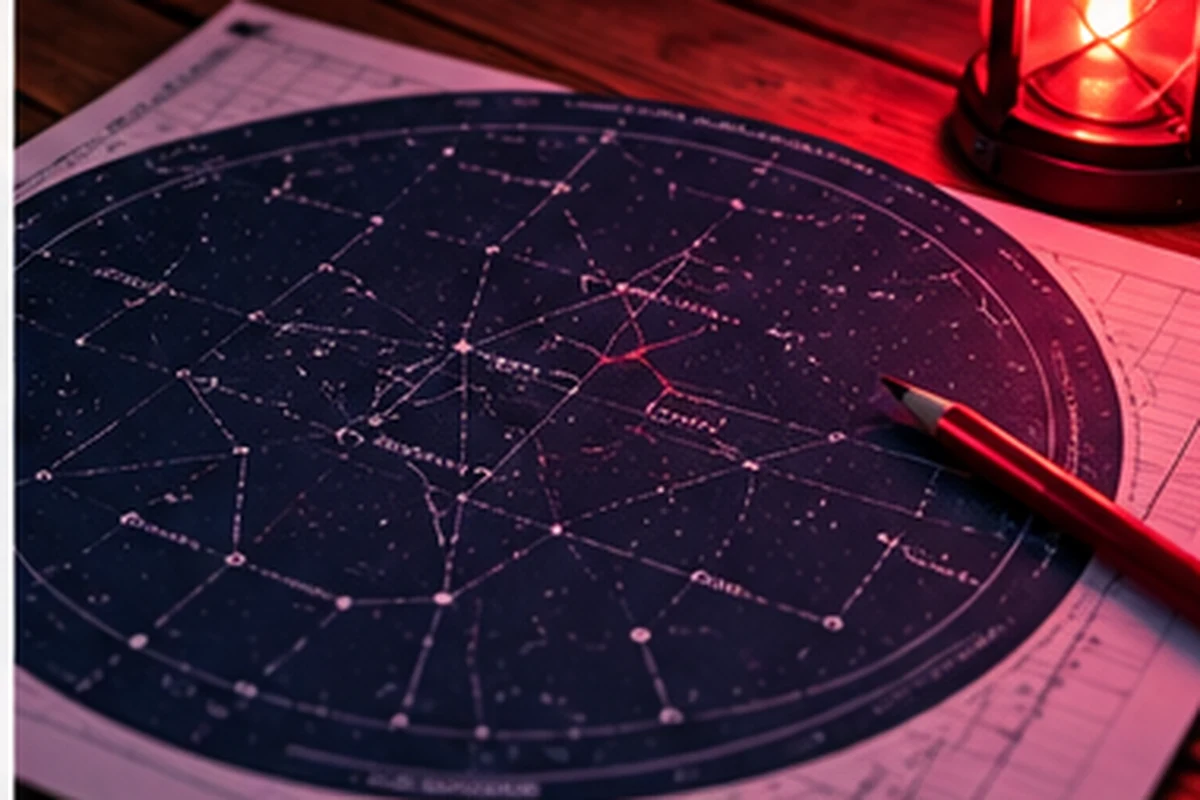
A planisphere tells you which stars and constellations are up tonight, and a star chart or atlas shows you where to point the telescope next. Both work well with a red light, because paper does not glow in your eyes the way a phone screen does and keeps your night vision intact. Pick a planisphere made for your latitude, a chart that matches how you star-hop, and a dim red light to read it.
What a planisphere does
A planisphere is two discs on one pivot: a star map underneath and a mask on top with an oval window. You turn the discs to line up the date with the time, and the window shows the part of the sky above the horizon at that moment. It answers the first question every observer has: what is up, and in which direction?
It is not a detailed map. It shows the brighter stars and the main constellations, and often a selection of well-known deep-sky objects. Think of it as the tool you pick up to orient yourself before you pick up the telescope. Planispheres are made for a range of latitudes, so check which one yours is made for. Our telescope gift guide makes the same point for buyers.
Planisphere, star atlas or phone app
| Tool | Good at | Weak at |
|---|---|---|
| Planisphere | Showing what is up tonight; learning constellations; works with no power | Fine detail; faint objects; planets and the Moon move, so they are not shown by the date setting alone |
| Star atlas or chart book | Finding faint targets; star-hopping with a finder; seeing many objects at once | Bulky; needs good light and some practice to match to the sky |
| Phone or tablet app | Updating itself for date, time and position; searching by name | Bright screen that hurts dark adaptation unless set to a night mode; battery drain in the cold |
None replaces the others. Many observers use a planisphere to find their way around, a chart for the telescope session and an app to look up what they cannot find. If you are choosing one thing to start with, a planisphere is the cheapest way to learn the sky, and it never runs out of battery.
Why paper and red light go together
Your eyes take time to adapt to the dark, and bright light undoes that quickly. Red light affects night vision less than white light, which is why observers read charts under a dim red lamp. A phone screen can be dimmed or put in a red mode, but a lit screen is still a light source aimed at your face, and a paper chart is not. Our dark adaptation guide explains the basics, and the red-light gear page and red astronomy headlamp guide cover the lights.
A few cautions help. Keep the light dim; a bright red lamp still costs you night vision. Test your chart under red light before the night, because some printed marks or colours can fade into the paper under red light. Matte, laminated charts reduce glare and survive dew. Use a clip, a clipboard or a string so you can read the chart with both hands free.
Check the listing for the latitude range it is made for and the date and time scales, and match it to where you observe.
Look for a true red setting and a dim level. Check the battery type before you buy.
Using a chart at the telescope
Charts and atlases are for star-hopping: you start from a bright star you know and move from star to star until you reach the target. A finder helps, and our guides to red-dot finders and RACI finderscopes explain the options. A red-dot finder shows the real sky without magnification, which is easy to match to a chart. A finderscope may show an upside-down or mirrored view, and a star diagonal can flip or mirror the view in the main telescope, so the chart may need turning to match.
That is the step that trips up beginners. Look at what your own optics do with the image, and then rotate the chart, not your head, to match. A short session with a bright star pattern in the evening, before it gets dark, teaches you your own setup. The same goes for your eyepieces: our eyepiece calculator helps you plan the field you will see, and a chart that marks the field is easier to use.
A simple star-hop routine
- Find your direction with the planisphere and a compass.
- Pick a bright star near the target on the chart.
- Centre it in the finder, then step to the next star on the chart.
- Check each step against the pattern in the finder.
- Switch to a low-power eyepiece to find the target, then increase power.
Habits that make paper easier to use
Learn the sky in the evening, before the telescope comes out. Turn the planisphere to the date and time, face the direction you want and name three or four bright stars or patterns. Once you can find a few anchor stars by eye, star-hopping at the telescope becomes much easier, and the chart stops being a puzzle.
Keep your kit together. A small clipboard or a plastic sleeve holds the chart, a pencil and a notebook, and a red light on a cord means you never have to hunt for it in the dark. Pencil notes on the chart, such as which finder star led you to a target, turn a generic tool into your own. Dew and wind are the enemies of paper, so a laminated chart or a sleeve earns its place on damp nights; our dew guide explains why damp air is the real problem on cold, clear evenings.
What to check before you buy
Scale matters more than people expect. A chart that crams the whole sky onto a page is good for finding your way and poor for finding a faint object, while a detailed atlas is the reverse. Match the chart to the job and to the telescope you own.
For a planisphere, check the latitude range, the size and the material. A larger disc is easier to read in the dark; a laminated or plastic one lasts longer outside. For an atlas, check what it shows: how many stars, what kinds of objects and whether the pages are laid out for observing at the telescope. A spiral binding lies flat on a table. Used atlases and planispheres are easy to find on marketplaces, and an older edition may serve well for stars, but check that it shows what you want to see and that no pages are missing.
Check what the atlas shows and how it is bound, and whether it suits the size of telescope you use.
If you are buying for someone else, see gifts for stargazers who do not own a telescope yet or our stocking stuffer guide, where a chart and a red light are natural pairs.
Use a planisphere to see what is up tonight and a chart or atlas to star-hop to a target. Read both under a dim red light so you keep your night vision, check the planisphere's latitude range and rotate the chart to match what your finder and diagonal show.
Sources and verification
No figures, latitude ranges or product claims are made. Check each planisphere listing for the latitude range it is made for, each atlas for what it shows, and your finder and diagonal manuals for how they orient the view.
Frequently asked questions
What is a planisphere?
A rotating star map with a window. You line up the date and time, and the window shows the part of the sky above the horizon at that moment.
Do I need a planisphere for a specific latitude?
Yes. Planispheres are made for a range of latitudes, so choose one for where you observe, and check the listing.
Why use a red light with a paper chart?
Red light affects your night vision less than white light, and a paper chart is not a light source, so you can read it without losing dark adaptation. Keep the light dim.
Is a star atlas better than a planisphere for a telescope?
They do different jobs. A planisphere shows what is up tonight, and an atlas shows fainter targets and the star patterns you need for star-hopping.
Why does my chart not match what I see in the finder?
Finders and star diagonals can flip or mirror the view. Look at what your own optics do and rotate the chart to match.