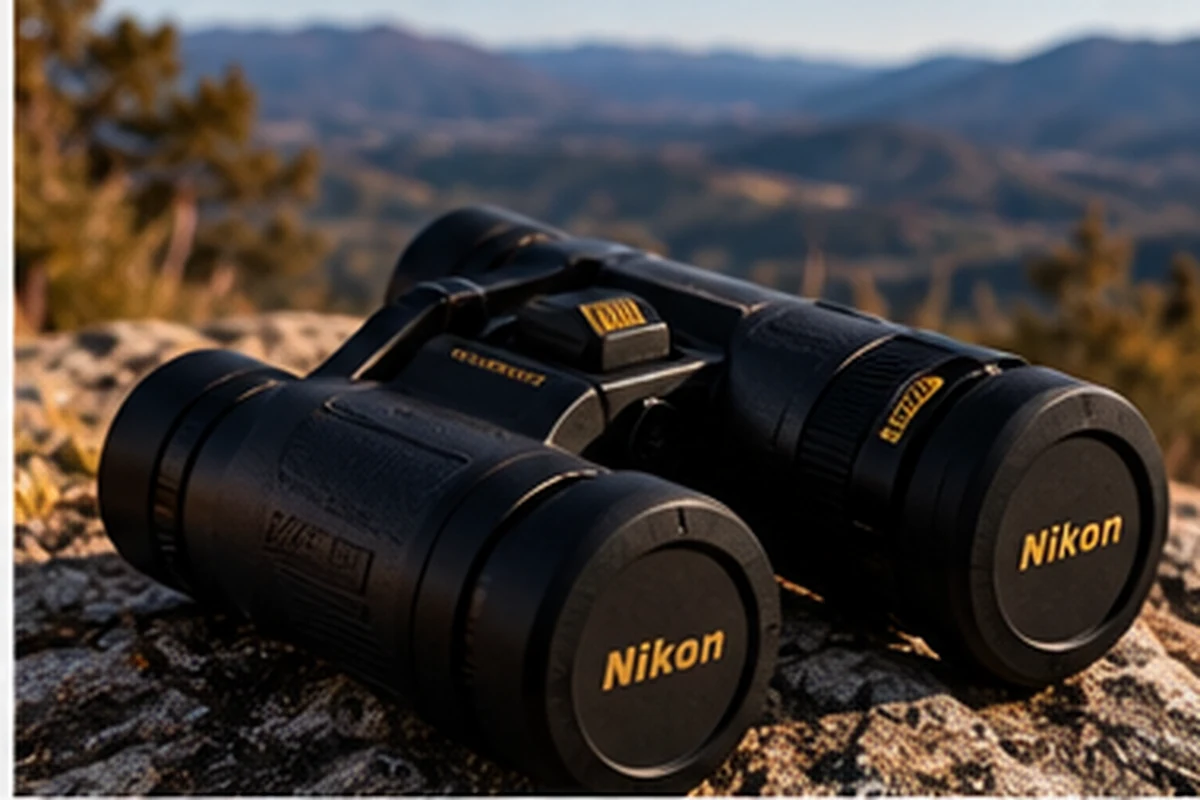
For handheld stargazing, 10x50 is the usual middle choice: more magnification than 7x50 and still steady enough to hold for a few minutes. Choose 7x50 for the widest, most forgiving view and the easiest hold. Choose 15x70 only if you will mount it on a tripod, because the extra power and weight make it hard to keep still by hand.
What the numbers mean
The first number is magnification: 10x makes things appear ten times closer. The second is the diameter of each front lens in millimetres. A bigger front lens gathers more light, but it also makes the binoculars heavier and bulkier. Everything else follows from that trade-off.
Dividing the second number by the first gives the exit pupil, the diameter of the beam of light leaving the eyepiece. That works out to about 7.1 mm for 7x50, 5 mm for 10x50 and a little under 5 mm for 15x70. A larger exit pupil gives a brighter, more relaxed view, but only if your eye's pupil opens wide enough to take it in, and a dark-adapted eye may open less as people get older. Our exit pupil guide and the dark adaptation guide explain how this works.
If you have not yet picked between binoculars and a telescope, read start with astronomy binoculars. This page assumes you have chosen binoculars and need the size.
The three sizes compared
| Size | Exit pupil | Holding by hand | Tripod | Best for |
|---|---|---|---|---|
| 7x50 | About 7.1 mm | Easiest of the three; shake is least noticeable | Helpful but optional | Wide sweeps of the Milky Way, scanning, casual use and beginners |
| 10x50 | 5 mm | Good for short looks; steadier with support | Recommended for longer sessions | An all-round choice for star clusters, the Moon and bright nebulae |
| 15x70 | A little under 5 mm | Hard to keep steady; heavy | Plan on one | Dedicated mounted use, fainter objects and finer detail |
Specific field-of-view figures vary by model, so check the maker's stated field for each pair. As a rule, lower magnification gives a wider field, which makes it easier to find things and to enjoy large star fields.
7x50: the wide, forgiving one
The low power and large exit pupil make 7x50 comfortable. It is easy to point, easy to hold and forgiving of small shakes. The trade-off is that objects look smaller, so fine details on the Moon or small clusters are less impressive. It suits people who mainly want to enjoy the Milky Way and large star fields from a dark site.
10x50: the usual all-rounder
This size gives noticeably more detail while remaining holdable. Many people find it comfortable for short views, and more so with support such as leaning against a wall or sitting in a reclining chair. See our guide to observing chairs for seating that suits binocular use. A tripod adapter makes longer sessions much less tiring on the arms.
15x70: the mounted one
Most people cannot hold 15x binoculars steady for long, and 70 mm lenses add weight. Treat this size as a tripod instrument. The payoff is a fainter and more detailed view for some targets, but only if the mount is sturdy. A flimsy tripod wastes the extra power. Check the stated weight, and confirm that your tripod and head are made to carry it.
Check the maker's stated field of view, weight and eye relief, and whether it has a tripod socket.
Plan on a tripod and check the stated weight and whether a tripod adapter is included or needed.
What each size suits in the sky
Large, bright targets suit every size. The Moon, the Pleiades and the star fields of the Milky Way reward the wide view of 7x50. Star clusters and the Andromeda Galaxy show well in 10x50 from a reasonably dark site, and with a steady hold the brightest moons of Jupiter are often visible too. Finer lunar detail and fainter objects are where a mounted 15x70 earns its keep.
Nobody can promise what you will see, because your sky, your eyes and the quality of a given pair all matter. Light pollution takes more from faint objects than any size can give back, so a modest pair at a dark site often beats a larger pair in town. If you plan to travel to dark skies, our dark-sky trip packing list covers what to take with the binoculars.
Holding, tripods and comfort
Whatever size you buy, steadiness decides how much you see. Rest your elbows on a fence, a car roof or your knees, and lean against something. For longer looks, a tripod with a binocular adapter, or a parallelogram-style mount, lets you look at overhead targets without a stiff neck. Check that the binoculars have a tripod socket and that the adapter or mount is made for them.
Weight is the hidden cost. A heavier pair tires your arms sooner, and tired arms shake. If you cannot hold a pair steady for a few minutes in the shop or at home, it will not work at night when you are looking up. Try before you buy where you can, or buy where returns are easy. Eye relief matters too: glasses wearers need enough distance between the eyepiece and the eye to see the whole view, so read that line in the maker's specification.
Some binoculars use image stabilisation, which needs a battery and a separate review of the manual; our astronomy binoculars page covers the class. For an apartment or balcony, see telescope for an apartment balcony, where handheld binoculars often make the most sense.
Check that it fits the binocular's tripod socket, and confirm the tripod can carry the weight.
How to choose
- Decide how you will hold them: by hand only, or with a tripod.
- Start with 7x50 or 10x50 for handheld use; save 15x70 for a tripod.
- Check the weight in the maker's specification and imagine holding it for a few minutes.
- Check eye relief if you wear glasses.
- Buy from a seller with clear return terms and test on the first clear night.
Buying used binoculars
Used binoculars are plentiful and often good value, but check them. Look through each barrel at a bright, distant object and make sure the two views merge into one clean image. Double images, eye strain or a headache can point to misalignment, which is a reason to return them. Inspect the lenses for haze, fungus and scratches, check that the focus wheel and the hinge move smoothly and look for dents that suggest a drop. Read the seller's return terms, and compare sold listings; our sold comps guide shows how.
If you are shopping for someone else, gifts for stargazers who do not own a telescope yet has related ideas.
Choose 10x50 as the usual handheld all-rounder, 7x50 for the widest and steadiest view, and 15x70 only if you will use a tripod. Check the maker's stated weight and eye relief, test used pairs for double images and haze, and read the seller's return terms.
Sources and verification
No field-of-view, weight or eye-relief figures are quoted for any model; the exit pupil figures are simple division of the lens size by the magnification. Check the maker's page for each pair, and read the seller's return terms before you buy.
Frequently asked questions
What do the numbers 10x50 mean on binoculars?
The first number is magnification and the second is the diameter of each front lens in millimetres. So 10x50 magnifies ten times with 50 mm lenses.
Which binoculars are best for handheld stargazing?
7x50 is the easiest to hold and gives the widest view, and 10x50 gives more detail while remaining holdable for short looks. Both are easier by hand than 15x70.
Do I need a tripod for 15x70 binoculars?
Plan on one. Most people cannot hold 15x binoculars steady for long, and 70 mm lenses add weight. Check that your tripod and adapter can carry them.
What is the exit pupil of 7x50 binoculars?
Divide the lens diameter by the magnification: 50 divided by 7 is about 7.1 mm. Your own eye needs to open that wide to use all of it.
Can I use binoculars if I wear glasses?
Check the eye relief in the maker's specification, because glasses wearers need enough eye relief to see the full view.