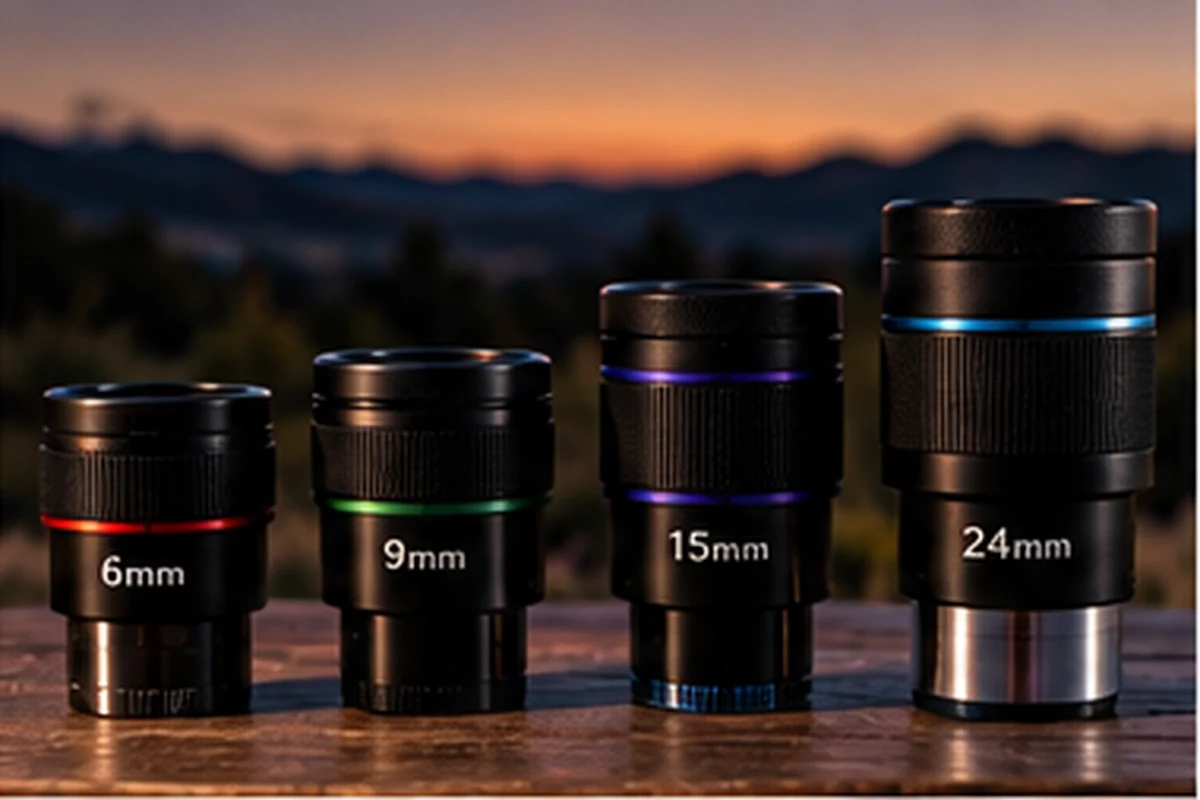
Buying for an amateur astronomer is tricky because so much of their gear has to fit something they already own. Get the barrel size or thread wrong and a thoughtful gift becomes a return. So this guide is split in two: gifts that fit any telescope, and upgrades where you need to check their setup first, with exactly what to check.
- Snap a photo of the telescope. The make, model, aperture and focal length are usually printed on the tube or a label.
- Look at their eyepieces. The barrel size, almost always 1.25-inch or 2-inch, decides which filters, Barlows and eyepieces will fit.
- Note the telescope type: reflector or Dobsonian, refractor, Schmidt-Cassegrain or Maksutov, or smart telescope.
- If they belong to an astronomy club, a fellow member can often tell you what they have been wanting.
Gifts that fit any telescope
No measuring, no compatibility risk. These are the safest picks and some of the most used.
A real astronomy red flashlight or headlamp
Eyes take a long time to adapt to the dark, and one blast of white light undoes it. A proper astronomy light starts very dim, stays red when switched on, and is easy to control with gloves. Almost every observer uses one every night.
Full guide: best red astronomy headlamps and flashlights
An adjustable observing chair
Sitting at the eyepiece is not a luxury. A relaxed observer sees more detail than one hunched over at an awkward angle. Adjustable-height chairs made for astronomy let them sit at the right height whether the telescope points low or high.
Full guide: best astronomy observing chairs
A star atlas or planisphere
Apps are handy, but a printed atlas or a rotating planisphere does not ruin dark adaptation, does not need a charge and works anywhere. Many observers keep both. Choose a planisphere made for their latitude.
An eyepiece or accessory case
Loose eyepieces in a shoebox get scratched and lost in the dark. A padded case with custom foam keeps everything protected and in the same spot every night, which matters when you are working by red light.
Full guide: best eyepiece cases
Upgrades where you check their gear first
These are often the most appreciated gifts, but each one has to match their telescope. The "check first" box tells you exactly what to confirm.
A Moon filter or variable polarizer
The Moon through a telescope can be uncomfortably bright. A neutral density Moon filter or an adjustable variable polarizer dims the glare and brings out detail along the terminator, the line between lunar day and night.
Full guide: best Moon filters and variable polarizers
A quality Barlow lens
A Barlow multiplies the magnification of every eyepiece they own, so a good one effectively doubles their eyepiece collection. Quality matters here; a poor Barlow softens every view.
Full guide: best Barlow lenses · Plan powers with the eyepiece calculator
A planetary or wide-field eyepiece
The eyepieces that ship with most telescopes are basic. One well-chosen upgrade, either a sharper high-power eyepiece for planets or a wide-field one for star clusters, is one of the biggest improvements you can give.
Full guides: best planetary eyepieces · best 1.25-inch eyepieces for beginners · building an eyepiece set without duplicates
A collimation tool, for reflector owners
Reflectors and Dobsonians need their mirrors lined up from time to time, especially after being moved. A collimation cap, Cheshire eyepiece or sight tube makes the job quick and repeatable, and a well-collimated telescope gives noticeably sharper views.
Full guides: Cheshire and sight-tube tools · laser collimators for Newtonians
A nebula filter
For visual observers, an OIII or UHC filter can make some emission nebulae stand out dramatically against the sky background. It does not help with galaxies or star clusters, so it suits someone who already hunts nebulae.
Full guide: best OIII filters for visual observing
A dew heater strap
On humid nights, dew can fog a lens or corrector plate in minutes and end the session. A heater strap wrapped around the front of the telescope keeps the glass slightly warmer than the air so dew cannot form.
Full guides: best dew heater straps · why dew ends observing nights
A portable power station
For anyone running a GoTo mount, dew heaters or a camera in the field, a portable power station replaces a tangle of batteries and car-adapter cables. It is a bigger gift, but one they will use every night out.
Full guides: best portable power stations for astronomy · field power in cold weather
For astrophotographers: a Bahtinov focus mask
Precise focus makes or breaks an astrophoto. A Bahtinov mask fits over the front of the telescope and creates a diffraction pattern on a bright star that shows exactly when focus is perfect. It is simple, inexpensive and genuinely useful.
Full guide: best Bahtinov masks
Shopping for a first telescope instead?
If the person does not have a telescope yet, start with the telescope gift guide, which matches the right telescope to kids, beginners, apartment dwellers and gadget lovers.
Related AstronomyEquipment guides
Frequently asked questions
What is a safe gift for an amateur astronomer if I don't know their gear?
A red astronomy flashlight or headlamp, an adjustable observing chair, a star atlas or planisphere, or a padded eyepiece case. None of these depend on the telescope model.
How do I know which eyepiece size to buy?
Look at the eyepieces they already use. The barrel is almost always 1.25-inch or 2-inch, and the size is usually printed on the eyepiece. Filters, Barlows and eyepieces need to match it.
Do all telescopes need collimation tools?
No. Reflectors and Dobsonians need periodic collimation, so tools are a useful gift for their owners. Refractors and most Maksutov-Cassegrains do not need routine collimation.
Is a nebula filter useful for every observer?
Not for everyone. OIII and UHC filters help mainly with emission nebulae and work best with moderate to large apertures under reasonably dark skies. They do not improve galaxies or star clusters.
What is a good gift for someone into astrophotography?
A Bahtinov focus mask is simple and genuinely useful, as long as you size it to the front of their telescope. A portable power station is a bigger option for powering mounts, cameras and dew heaters in the field.