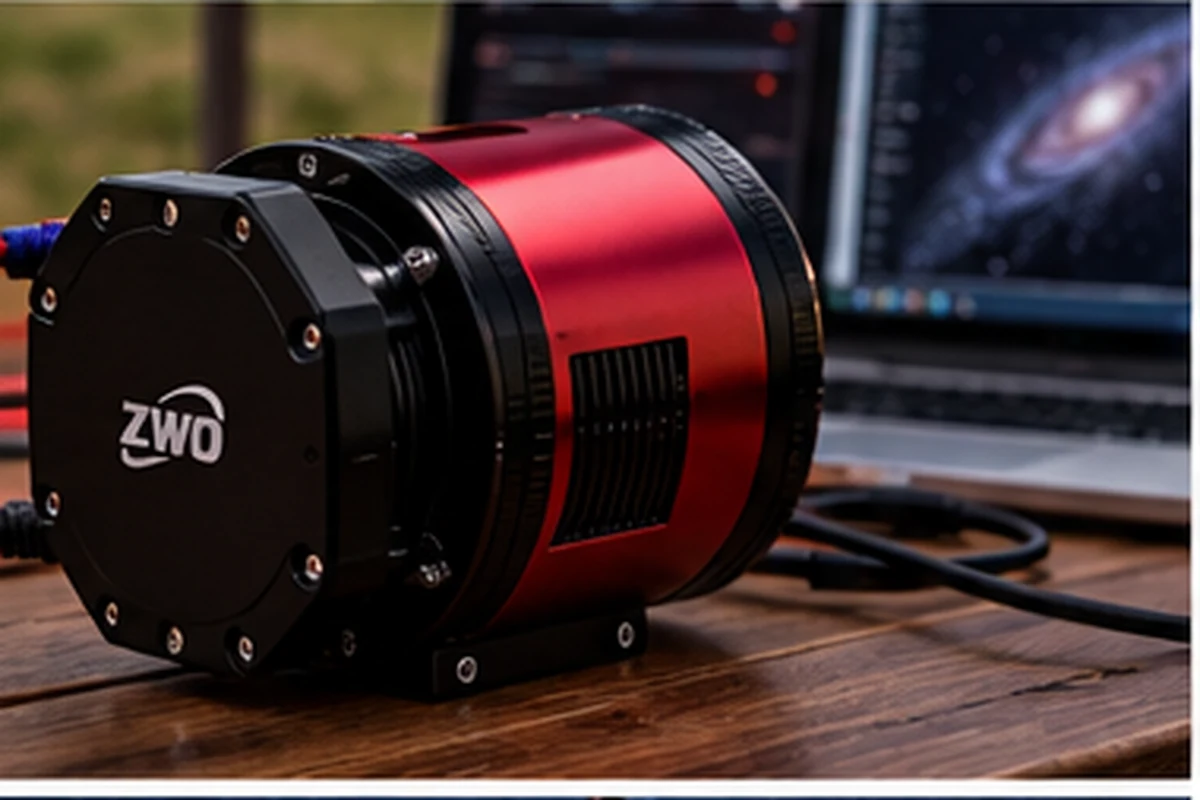
Cooling is worth paying for when you shoot long exposures of faint nebulae and galaxies regularly and are ready for the extra gear that comes with a dedicated camera. If you already own a camera body, are still learning the basics or have not yet got a steady mount and tracking sorted, a DSLR or mirrorless body, modified or not, is usually the better first step. The mount, lens or telescope often limits your results before the camera does.
What cooling actually does
Sensors build up thermal noise during long exposures, and the warmer the sensor, the more noise. Wikipedia's astrophotography article notes that professional astronomical cameras cool their sensors to reduce thermal noise, and that consumer DSLRs otherwise suffer from noise in long exposures. A cooled camera holds the sensor at a chosen temperature, which AstroBackyard describes as making calibration easier, because a DSLR sensor warms during a night and cannot be precisely regulated.
That regulation is the practical benefit. Calibration frames such as darks are most useful when they match the temperature of your light frames. A vendor page from a camera maker, ToupTek, recommends regulated cooling for this reason and calls cooling highly recommended for serious deep-sky work. Treat the vendor view as one input: it sells the cameras it recommends.
Noise can also be reduced without cooling. Wikipedia notes that subtracting dark frames and stacking many images reduce noise, which is how many DSLR imagers work.
What a modified DSLR changes
Many stock cameras include a strong infrared-cut filter that holds back the deep red light from hydrogen-alpha nebulae. A modified camera has that filter changed or replaced so more of that light reaches the sensor. Wikipedia gives the example of a factory camera sold with a modified infrared filter and greater hydrogen-alpha sensitivity for red emission nebulae. AstroBackyard says dedicated astronomy cameras typically avoid that strong filtering, though it does not discuss modified DSLRs.
Modification does not cool the sensor and it may change colour rendering in everyday photos, so ask the modifier what to expect. Check the camera maker's warranty terms and the modifier's terms before sending a body away or buying one that has been modified.
| Question | Modified DSLR or mirrorless | Cooled astronomy camera |
|---|---|---|
| Temperature control | Sensor warms during use and cannot be precisely regulated | Holds a set temperature through the night |
| Power and control | Self-contained: screen, battery, storage | Usually external power and a computer or controller |
| Red nebula response | Improved if the filter is modified | Typically avoids the strong filtering of stock cameras |
| Everyday use | Still a normal camera | Astronomy only |
| Cost trade-off | An older body can be cheap, and you may own one | Cooling and specialisation are the value, and the accessories add up |
Side by side for a beginner
AstroBackyard calls a DSLR the easiest and most flexible starting point, especially if you already own one, while noting that dedicated cameras are far less complicated to set up than they used to be. It also advises spending money on a tracker, mount or lens before a dedicated camera. That advice fits a beginner: the best camera on a shaky mount gives poor pictures. Our guides to why a stable mount beats more magnification and the star trackers for camera work explain where the money goes first.
If you start with a camera body, you can use a lens alone before adding a telescope; our guide to camera lenses for astrophotography without a telescope covers that route.
What a cooled camera adds to your setup
A cooled camera is a bigger commitment than the sensor suggests. It usually needs external power for the cooler, a computer or small controller to run it and capture software, and cables that you must manage in the dark. Check the manual for the supply it needs and plan the power before you buy; our portable power station guide covers the field side, and the electrical details are the maker's to specify.
It also needs spacing. The camera has to sit at the distance the maker specifies from any reducer or flattener, so the adapter stack matters. See our backfocus guide and the cooled astronomy cameras page. If you choose a one-shot-colour model over a monochrome one, ToupTek recommends starting with colour, a vendor view that suits beginners because it avoids a filter wheel; the site's one-shot colour page explains the trade-off.
Check the cooling method, the power it needs, the sensor type and the spacing the maker specifies before you buy.
A sensible upgrade path
You do not have to choose once and for all. A common route is to start with the camera you have on a tripod or tracker and a wide lens, add a small telescope on a mount that tracks well, and only then ask whether the camera is the weak link. By that point you will know how long your exposures run, how your mount behaves and whether you enjoy the computer side of the hobby, which are the real questions behind the cooling decision.
Calibration is the other thing to learn before you spend. Whatever camera you use, dark frames and stacking are part of the routine, and your stacking software's instructions tell you how to take them. A cooled camera makes that routine more repeatable, but it does not remove it.
When cooling is worth it, and when to wait
- It is worth it if you image faint objects for long totals, want repeatable calibration and are comfortable with a computer at the telescope.
- Wait if you do not yet have steady tracking, guiding or a mount that can carry the load, or if you only want casual shots.
- Consider a modified body if you want a hydrogen-alpha response and prefer a self-contained camera, and you have read the warranty terms.
- Keep your own body if you also want it for everyday photography.
Buying either one used
Used cooled cameras turn up on marketplaces, and so do bodies that sellers describe as astro-modified. For a cooled camera, ask whether the cooler and fan work, what power supply and cables come with it and whether there is any moisture on the sensor window. For a modified body, ask exactly what was done, by whom and what filter is installed, and ask for test images. Photos of a listing do not prove performance, so read the seller's return terms and compare sold listings; our sold comps guide shows how.
Ask what modification was done and by whom, request sample images and read the return terms.
For the camera route in general, see the DSLR astrophotography page.
Cooling pays off for regular long exposures of faint objects if you are ready for external power, a computer and careful spacing. A DSLR or mirrorless body, modified or not, is the easier start, especially if you own one. Put money into a stable mount, a tracker or a lens first, and check warranty and return terms.
Sources and verification
- AstroBackyard, DSLR versus dedicated astronomy camera: cooling regulation and calibration, power, computer and software needs, DSLR as an easy start and money first into mount, tracker or lens.
- ToupTek Astro, choosing a deep-sky camera (vendor page): regulated cooling for matching dark frames, and starting with one-shot colour; this is a seller's view.
- Wikipedia, astrophotography (secondary source): cooling to reduce thermal noise, modified infrared filters, and dark-frame subtraction and stacking.
No temperatures, prices, power figures or model claims are made. Check each maker's page for cooling, power and spacing, and the camera maker's and modifier's terms for warranty.
Frequently asked questions
Does a cooled astronomy camera give better results than a DSLR?
Cooling reduces thermal noise and lets you keep the sensor at a steady temperature. That matters most for long exposures of faint objects, but a steady mount and good technique matter first.
What does it mean for a DSLR to be modified?
Many stock cameras use a strong infrared-cut filter that holds back red hydrogen-alpha light. A modified camera has it altered or replaced. It does not cool the sensor.
Do I need a computer for a cooled camera?
Usually, or a small controller. Check the manual for the power and software the camera needs before you buy.
Can I reduce noise with a DSLR without cooling?
Yes. Subtracting dark frames and stacking many images reduce noise, as Wikipedia notes.
Is a one-shot colour or a mono camera better to start with?
ToupTek, a camera vendor, recommends starting with a one-shot colour model. Mono cameras are used with filters, which adds equipment and steps.