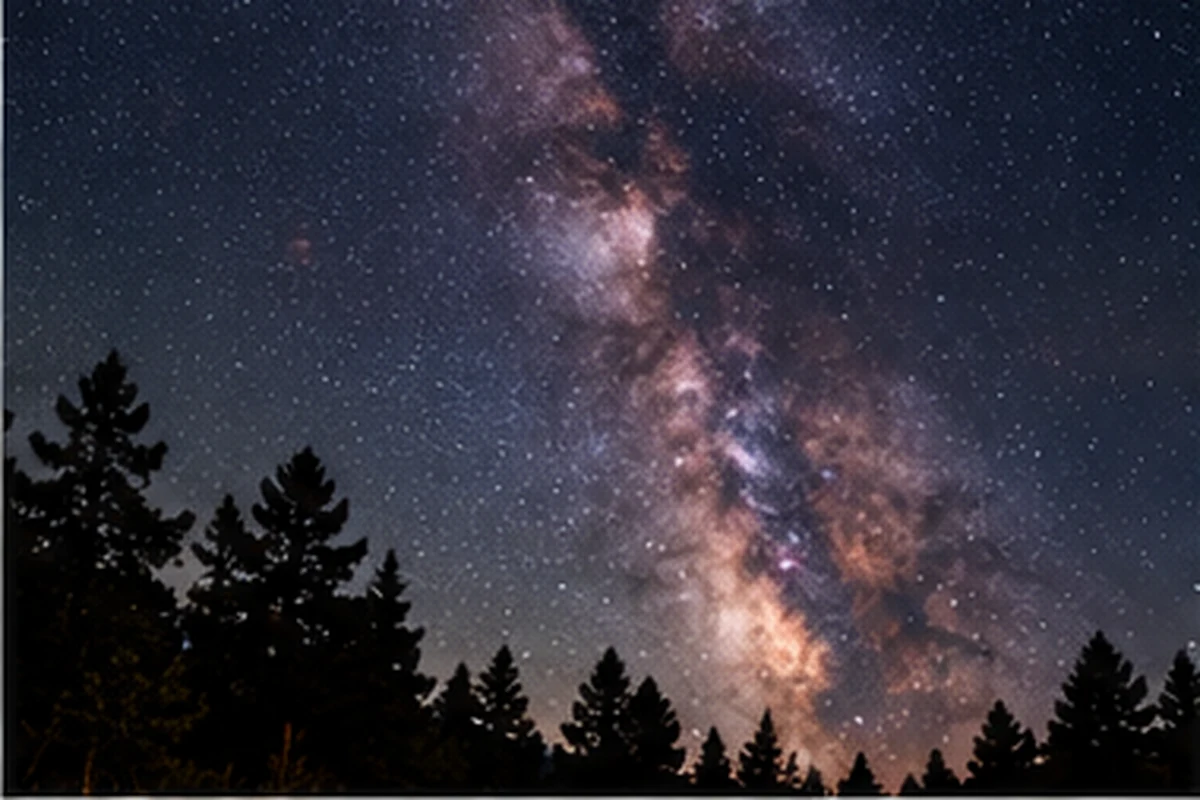
For night-sky photos without a telescope, look for a wide, fast lens that fits your camera: a focal length in the wide range, a wide maximum aperture, manual focus you can set precisely, and a mount that matches your body. Space.com's beginner guide points to roughly 12 to 35 mm and an aperture of f/2.8 or faster as the target. Everything else on this page is about checking those points before you buy.
What matters in a lens for the night sky
A telescope is not required to photograph the Milky Way, constellations or a starry landscape. A camera on a tripod with a suitable lens will do it. The lens does the work a telescope would do, so its specifications matter more than the camera's megapixels. Four things count: how wide it sees, how much light it gathers, how it renders stars across the frame and whether you can lock focus on a bright star.
| Check | Why it matters | What to look for |
|---|---|---|
| Focal length | Sets how much sky fits in the frame and how long you can expose before stars trail | A wide lens; Space.com suggests roughly 12 to 35 mm |
| Maximum aperture | A wider opening gathers more light in a short exposure | f/2.8 or faster is the guide's ideal; a kit lens at its widest setting is fine for practice |
| Star shape at the edges | Some lenses smear stars near the corners at wide apertures | Look at sample night photos for the exact lens and test yours |
| Manual focus | Autofocus struggles on dim stars | A focus ring you can set by hand, ideally one that does not drift |
| Mount | The lens must connect to your camera body | Match the lens mount to your body, or follow the maker's adapter advice |
Focal length and the field of view
Wide lenses take in more sky and let you expose longer before the Earth's rotation turns stars into short streaks. Tamron's guide notes that wider focal lengths such as 16 or 20 mm capture more sky and help limit trailing. Wikipedia's astrophotography article makes the same point: longer lenses show trailing within seconds.
A common starting rule divides 500 by the focal length to estimate the longest exposure, so a 20 mm lens gives about 25 seconds. Space.com and Tamron both give that example and suggest starting around 20 to 30 seconds and adjusting. Sources differ on how to adjust the rule for smaller sensors, and Wikipedia adds that a more accurate answer depends on pixel size and where you point. Treat the rule as a starting guess: take a test frame, zoom in on the stars and shorten the exposure if they look like dashes.
If your camera has a smaller sensor, the same lens frames a narrower view than it would on a full-frame body. Check the maker's specifications for how the lens behaves on your camera before relying on a focal-length figure in a listing.
Zoom lenses add flexibility, but check the widest aperture at the focal length you plan to use, because some zooms let in less light when zoomed in. A fixed prime lens has one focal length and often one clear aperture figure, which makes the specification easier to read. If a listing quotes a field of view or an "equivalent" focal length, find the real focal length and your sensor size before comparing it with the figures above.
Aperture and how stars look at the edges
A wider aperture lets you keep exposures short and the sensitivity setting lower, which helps with noise. Space.com suggests buying the fastest lens you can and notes that a stock kit lens used at its widest aperture, typically around f/4, is acceptable to practise with. Faster prime lenses can be sharper but usually cost more.
The catch is star shape. Many lenses are weakest at the corners when wide open, and the stars there can stretch or smear. Reviews and sample photos of the exact lens are the best guide. If stars look soft at the edge, closing the aperture a little often helps, at the cost of light. No single number tells you this, so look at real night-sky samples before you buy.
Focusing and the habits that help
Switch the lens to manual focus. Space.com explains the method: use live view, magnify a bright star on the screen and turn the focus ring until the star is as small and sharp as you can get it. It adds that simply setting the ring to the infinity mark is not enough. Tamron suggests securing the focus ring with gaffer's tape once set, and switching off image stabilisation on the camera and lens when the camera is on a tripod.
A tripod is essential, ideally with a smooth tilt head and quality lockable parts, and a remote release or self-timer keeps you from shaking the camera. Our star tracker guide covers the step up when you want longer exposures with a fixed lens, and red astronomy lights help you handle the camera without losing your night vision.
Match the lens mount to your camera body and check the listing for the maximum aperture and focus type.
Check the camera model against the product description and your camera manual before ordering.
Buying new or used
Used lenses are a sensible way to get a fast wide lens for less, and manual-focus lenses can be a good fit for a task where you focus by hand anyway. Whether a given lens will mount on your body, or needs an adapter, depends on the camera and lens makers, so confirm it from their own compatibility information instead of the seller's description. A listing that says "fits all cameras" is a reason to ask questions.
Inspect the glass in the photos and the description: look for haze, fungus, scratches and sticky aperture blades, and check that the focus ring turns smoothly. Ask what is included, such as caps and a hood, and read the seller's return terms. Our guide to comparing used gear with sold listings works for lenses as well as telescopes.
Check the mount, the aperture and the condition photos. Confirm compatibility with your camera body from the maker.
If you later add a telescope, you will need a T-ring and adapters for your camera system; see our T-ring and camera adapter guide. For ideas on gifting this kit, see gifts for a photographer curious about astrophotography, and for how a camera body fits into deep-sky work, see the site's DSLR astrophotography page.
Quick pre-buy checklist
- Confirm the mount against your camera body.
- Pick a wide focal length and the widest aperture you can afford.
- Look for night-sky sample photos from that exact lens.
- Check for a smooth manual focus ring.
- Plan a tripod, a release or timer and a red light.
Look for a wide, fast lens that fits your camera, with manual focus you can set on a bright star. Space.com's guide suggests roughly 12 to 35 mm and f/2.8 or faster. Check sample star shapes at the corners, use a tripod and a remote release or timer, and confirm mount compatibility with the makers.
Sources and verification
- Space.com, astrophotography for beginners: the 12 to 35 mm and f/2.8 or faster guidance, kit lens at its widest aperture for practice, manual focus on a magnified star, tripod and remote release, and the 500 rule as a starting point.
- Tamron, a beginner's guide to night sky photography: wide focal lengths limiting trailing, starting exposures of 20 to 30 seconds, taping the focus ring and turning stabilisation off on a tripod.
- Wikipedia, astrophotography (secondary source): longer lenses showing trailing within seconds and the 500 rule depending on more than focal length.
No lens models, prices or compatibility claims are made. Confirm your camera's lens mount and any adapter needs with the camera and lens makers, and check sample photos for star shape at the corners.
Frequently asked questions
What lens do I need for astrophotography without a telescope?
A wide, fast lens. Space.com suggests roughly 12 to 35 mm with an aperture of f/2.8 or faster as the ideal, and a kit lens at its widest setting is fine for practice.
What does the 500 rule mean?
It is a rule of thumb: divide 500 by the lens focal length to estimate the longest exposure before stars start to trail, so a 20 mm lens gives about 25 seconds. Treat it as a starting guess and check your test frames.
Should I focus at infinity?
No. Switch to manual focus, magnify a bright star in live view and focus until it is as small and sharp as possible. Setting the ring to the infinity mark is not enough.
Do I need image stabilisation for night photos?
Turn it off on the camera and the lens when the camera is on a tripod, as Tamron advises, and check your lens manual.
Can I buy a used lens for astrophotography?
Yes, if you check the mount, inspect the glass for haze and fungus, make sure the focus ring is smooth and read the seller's return terms.