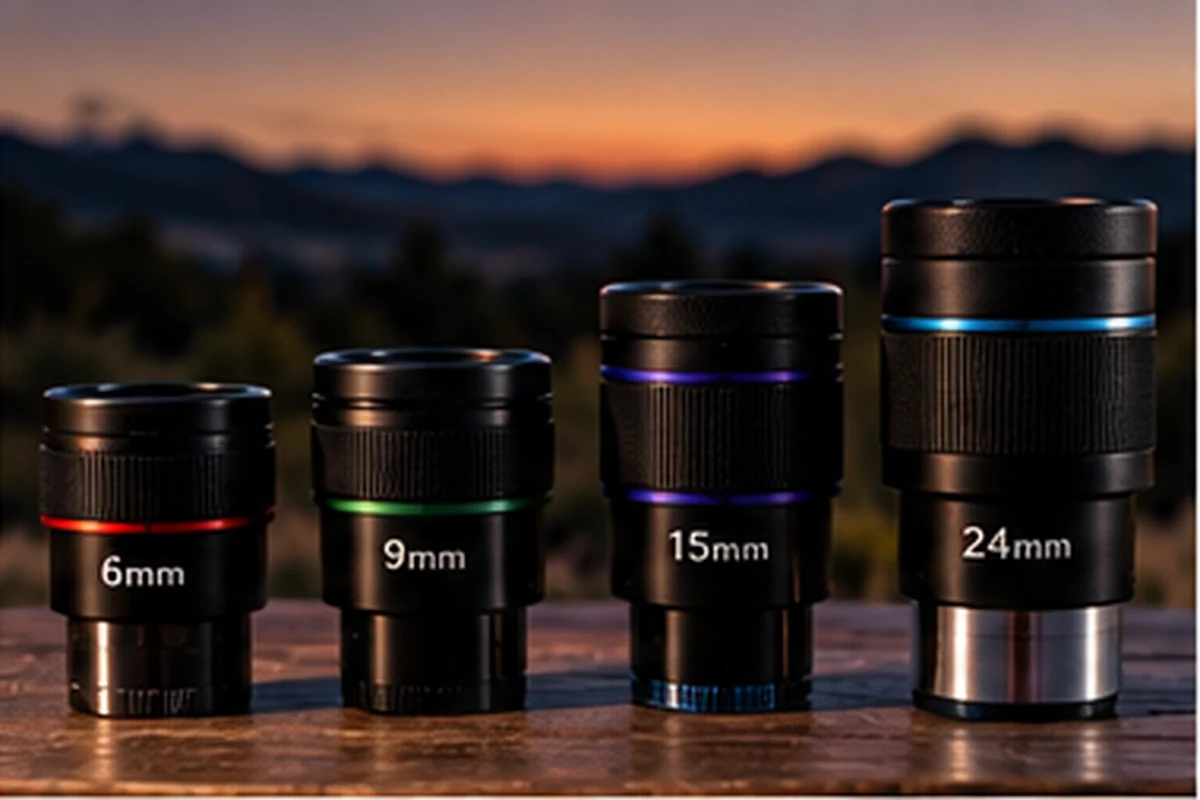
Before you order any telescope accessory, match three connections: the barrel size where it slides into the focuser or diagonal, the thread where it screws on, and the dovetail where it clamps to a mount. Most return headaches come from a part that fits one of these but not the others. This page gives you a check for each, using what the makers and reference sources say, and tells you where to confirm the rest.
Why parts that look right still do not fit
Telescope gear has no single connection standard. Eyepieces, diagonals and cameras slide into barrels of different diameters, screw onto threads with different pitches, and clamp onto dovetail bars of different widths. A listing that says "universal" or "fits most telescopes" has not told you which connection it uses. Your job is to find out which one your telescope has, then look for the same word on the part.
Write down the connection on both sides of every join before you buy: the telescope's focuser and the part, the part and the next part, and the tube and the mount. Our first telescope guide makes the same point about building the whole system, not one item.
| Connection | What must match | Where to confirm |
|---|---|---|
| Barrel (slide-in) | The barrel diameter of the part and the focuser or diagonal | Your telescope manual and the product description |
| Thread (screw-on) | Thread size and pitch of both parts | The maker's specification for each part |
| Camera mount | Camera body mount type and the adapter made for it | The camera and adapter makers' compatibility information |
| Dovetail | Bar style on the tube and the saddle style on the mount | The mount manual and the saddle or bar description |
| Spacing | Distance from the focuser to the sensor or eyepiece | The maker's required spacing for the camera or reducer |
Barrel sizes
Wikipedia's eyepiece article lists the standard barrel diameters for telescope eyepieces as 0.965 inch, 1.25 inch and 2 inch. The 0.965-inch size is the smallest and is usually found on toy-store telescopes. The 1.25-inch size is the most popular. The 2-inch size is the largest in common use, allowing longer focal lengths, and the page notes that these eyepieces tend to cost more, may not fit some telescopes and can be heavy enough to tip a telescope.
In practice that means three checks. First, find which sizes your focuser and diagonal accept. Some focusers take both 2-inch and 1.25-inch with a reducer sleeve, and some take only one, so check the manual. Second, confirm the barrel on the part. Third, think about weight: a heavy 2-inch part can throw a light telescope out of balance. Our guides to 1.25-inch eyepieces for beginners, star diagonals and Barlow lenses show how those parts list their barrel sizes.
Adapters between barrel sizes exist, but they change how the part sits. A sleeve that lets a smaller barrel into a larger focuser can add a little length, and a heavy part on a small barrel can slip. Tighten the thumbscrews or compression ring only as the manual allows, because overtightening can mark the barrel.
Threads and camera adapters
Wikipedia describes the T-mount as a male thread of 42 mm diameter and 0.75 mm pitch, and notes that it is distinct from the M42 mount, which has a 1 mm pitch. They look similar and do not interchange, which is a classic ordering mistake. If a listing says only "M42", find out which pitch it means before you buy.
The same article explains how cameras connect. A T-ring is a simple adapter that lets a T-mount part attach to a camera body with a shorter flange distance. A T-adapter has an inner ring with the T-thread and an outer ring that matches a specific camera lens mount. The camera side is therefore specific to your brand and mount, while the telescope side is the standard thread. Wikipedia also notes that T-mounts are a standard way to attach a camera to a 1.25-inch telescope eyepiece barrel.
Filters and other accessories thread onto eyepiece barrels and other parts, and the sizes are not interchangeable. Do not guess: read the thread on the filter listing and compare it with the thread on your eyepiece or adapter. Our T-ring and camera adapter guide and the camera adapters page go deeper on the camera side.
Pick the adapter made for your camera body and check that the telescope side matches the thread described in your manual.
Dovetails and saddles
Most telescopes attach to a mount with a dovetail bar on the tube and a saddle on the mount that clamps it. Two styles are common. A retailer's page for a dual saddle describes them by width: Vixen-style as a narrow profile and Losmandy D-style as a wide profile, with a dual-channel saddle designed to grip both. That page gives no numeric widths, so the safe approach is to read the style names on both parts instead of measuring by eye.
Converters exist for changing between the two styles, and one retailer lists a converter for taking a Losmandy D-series mount to the Vixen V-series style, noting that you must check your own mount and saddle dimensions before buying. The same dual-saddle page warns that replacing a factory saddle needs a check against your mount's bolt pattern and attachment method. In short, matching style is only half the job; the saddle must also bolt to your mount. Our dovetail bars page covers the hardware.
Confirm the bar style, the saddle style and the mount attachment from the product description and your mount manual.
Spacing, backfocus and how to verify a fit
Even when every barrel, thread and dovetail matches, a camera or reducer may need a specific distance to the sensor. That distance is set by the maker, and the stack of adapters adds up. Our guides to what backfocus actually means and the backfocus guide explain how to count it.
A Schmidt-Cassegrain telescope adds a wrinkle. Consumer models focus by moving the primary mirror, and Wikipedia notes that this can shift the image, so a focuser upgrade on that design is a different job from one on a refractor or Dobsonian.
A fit-check routine
- Name the connection on each side of every join, in words from the manuals.
- Look for the same name in the listing, not just "fits most".
- Ask the seller to confirm in writing for used parts, and compare sold listings for the same part.
- Check weight and balance for large parts.
- Read the return terms and test the fit on the first clear night.
Used parts are where compatibility mistakes are costly, because photos rarely show the thread. Ask for a photo of the thread or the maker's label, and read the return terms before you pay.
Match the barrel size, the thread and the dovetail style on both sides of every join before you buy, using the names in your manuals rather than "fits most". Confirm camera adapters for your body, check that a saddle bolts to your mount, and count spacing for cameras and reducers.
Sources and verification
- Wikipedia, eyepiece (secondary source): the standard barrel diameters and the notes on the 0.965-inch and 2-inch sizes.
- Wikipedia, T-mount (secondary source): the T-thread specification, how it differs from M42, and the T-ring and T-adapter descriptions.
- Astronomics, dual dovetail saddle listing (retailer page): Vixen-style as narrow and Losmandy D-style as wide, and the advice to check bolt pattern and attachment.
- Agena Astro, dovetail converter listing (retailer page): that converters between the two styles are sold and that your own dimensions must be checked.
- Wikipedia, Schmidt-Cassegrain telescope (secondary source): consumer models focus by moving the primary mirror, which can shift the image.
No numeric dovetail widths, filter thread sizes or model compatibility claims are made. Confirm each connection in your telescope, mount, camera and accessory manuals, and with the seller before you buy.
Frequently asked questions
What barrel sizes do telescope eyepieces use?
Wikipedia lists 0.965 inch, 1.25 inch and 2 inch as the standard sizes, with 1.25 inch the most popular. Check which your focuser and diagonal accept in the manual.
Is a T-thread the same as an M42 thread?
No. Wikipedia describes the T-mount as 42 mm with a 0.75 mm pitch and the M42 mount as having a 1 mm pitch, so they do not interchange.
What is the difference between a T-ring and a T-adapter?
A T-ring lets a T-mount part attach to a camera body. A T-adapter has an inner ring with the T-thread and an outer ring that matches a specific camera lens mount. Confirm which your camera needs.
What is the difference between Vixen-style and Losmandy-style dovetails?
A retailer page describes Vixen-style as the narrow profile and Losmandy D-style as the wide profile. Check the style on both the bar and the mount saddle before ordering.
Will an adapter fix any mismatch?
Not always. Adapters add length and weight, and the saddle must also bolt to your mount. Check the maker's information for each part.